
Inside the $1 Trillion Company Club 💰
August 05, 2026 — ny_wk
As an Amazon Associate I earn from qualifying purchases.
August 05, 2026 — ny_wk
Disclosure: some links above are affiliate links — if you buy through them I may earn a small commission at no extra cost to you. Thanks for supporting the channel!
The exclusive trillion-dollar company club represents the pinnacle of corporate achievement, a rare stratum where innovation, market dominance, and sheer economic power converge to redefine global commerce. Joining this elite group signifies more than just immense wealth; it marks a company as a colossal force shaping technological landscapes, consumer behavior, and even geopolitical dynamics.
For most of history, achieving a market capitalization of $1 trillion seemed like an insurmountable peak. Today, a handful of titans not only stand on this summit but continue to push the boundaries of valuation, driven by relentless innovation, strategic market capture, and increasingly, the transformative power of artificial intelligence. Understanding what propels these behemoths into the $1 trillion company club and keeps them there offers a fascinating glimpse into the future of business and technology.
What exactly defines a "trillion-dollar company"? it's about market capitalization – the total value of a company's outstanding shares. Simply put, it's the stock price multiplied by the number of shares in circulation. But reaching and sustaining a trillion-dollar valuation is far from simple; it requires a confluence of strategic foresight, groundbreaking products, and an iron grip on global markets. These aren't just large companies; they are economic ecosystems in themselves, often boasting revenues comparable to the GDP of small nations.
The journey to the trillion-dollar mark is often decades in the making, built on successive waves of innovation. Historically, the industrial revolution produced its own giants, but the scale and speed of wealth creation in the digital age are unprecedented. The 21st century has seen technology companies dominate this club, a sign of the intangible value of software, data, and network effects. Unlike traditional industries reliant on physical assets, tech giants leverage intellectual property, algorithms, and vast user bases to create exponential growth, making them uniquely positioned to scale to such dizzying heights.
The first company to officially close with a market cap over $1 trillion was Apple in August 2018, a monumental achievement that broke a psychological barrier. This event signaled a new era, demonstrating the immense potential of consumer electronics, software ecosystems, and a brand built on design and user experience. Following Apple, other tech giants quickly joined the ranks, each with its own distinct formula for success, highlighting varied pathways to ultimate market supremacy. These companies don't just sell products; they sell platforms, services, and entirely new ways of living and working.
Key drivers behind this hyper-growth include:
When we talk about the trillion-dollar company club, we are primarily talking about the titans of technology. These companies haven't just adapted to the digital age; they've defined it. Their success stories are varied, but a common thread ties them together: an unparalleled ability to innovate, scale, and integrate disruptive technologies, with artificial intelligence now emerging as the ultimate competitive differentiator.
Apple's journey to the trillion-dollar mark, and beyond, is a masterclass in brand loyalty, design excellence, and ecosystem integration. From the iPhone to Macs, Apple Watch, and its burgeoning services division (Apple Music, Apple TV+, iCloud), the company has built a walled garden that users willingly enter. Its strong brand identity allows it to command premium prices, while its global supply chain and marketing prowess ensure widespread availability. Apple's relentless focus on the user experience, combined with powerful hardware and intuitive software, creates a compelling value proposition that few can match.
For Apple, AI is subtly woven into the fabric of its products, from Siri and on-device machine learning for privacy-preserving features to advanced computational photography and personalized recommendations. While often less vocal about its AI advancements than some peers, Apple integrates AI to enhance usability, security, and the overall intelligence of its ecosystem, making its devices indispensable.
Microsoft's resurgence under Satya Nadella has been spectacular, transforming a traditional software giant into a cloud computing powerhouse. Azure, its cloud platform, is a cornerstone of digital transformation for businesses worldwide, providing scalable infrastructure and services. Coupled with its enduring Windows operating system, the ubiquitous Office 365 suite, and its aggressive expansion into gaming with Xbox, Microsoft has diversified its revenue streams while maintaining its dominance in enterprise software. Their ability to serve both consumers and businesses across various segments gives them immense stability and growth potential.
Microsoft has made massive bets on AI, integrating it across its product lines. From AI-powered features in Office 365 (think Copilot) and the intelligence woven into Windows, to its significant investment in OpenAI and the integration of large language models (LLMs) into Azure services, AI is central to Microsoft's future. It's not just a feature; it's a foundational technology that enhances productivity, powers cloud infrastructure, and opens up new possibilities for its vast enterprise customer base.
Alphabet, the parent company of Google, built its empire on search and online advertising, creating an unparalleled data flywheel. Google Search, Android, YouTube, Chrome, and Maps are not just products; they are platforms used by billions, generating an immense amount of data. This data, coupled with Google's advanced algorithms, allows for incredibly precise ad targeting, making it a cornerstone of the digital economy. Beyond advertising, Alphabet is a leader in autonomous driving (Waymo) and life sciences (Verily), showcasing its "moonshot" approach to innovation.
Perhaps no company has invested more deeply and broadly in AI than Google. From the algorithms that power its search engine and recommendation systems on YouTube to its groundbreaking work in machine learning (TensorFlow) and LLMs (LaMDA, Gemini), AI is Google's DNA. Its vast data centers and computational power are optimized for AI workloads, giving it a significant advantage in developing and deploying cutting-edge AI technologies that further entrench its market position.
Amazon started as an online bookstore and evolved into the "everything store," revolutionizing retail with its relentless focus on customer convenience, vast selection, and speedy delivery. Its Prime membership program created unparalleled customer loyalty. Crucially, Amazon Web Services (AWS) emerged from its internal infrastructure needs to become the leading cloud computing platform globally, a highly profitable business segment that underpins countless websites and digital services. This dual dominance in both consumer e-commerce and enterprise cloud infrastructure provides Amazon with immense market power.
AI is fundamental to Amazon's operations. Recommendation engines drive personalized shopping experiences, optimizing sales. AI-powered logistics and robotics streamline warehouse operations, enabling faster delivery. AWS provides AI services (e.g., machine learning platforms, natural language processing tools) to its vast customer base, democratizing AI adoption. And of course, Alexa, its voice AI assistant, is a pioneer in smart home technology, showcasing Amazon's commitment to integrating AI into daily life.
While a relatively newer entrant to the sustained trillion-dollar club, Nvidia's meteoric rise is perhaps the most compelling story of how a company can position itself at the nexus of a technological revolution. Originally famous for its graphics processing units (GPUs) in gaming, Nvidia recognized early on that GPUs were uniquely suited for parallel processing tasks, making them ideal for training complex AI models. This strategic pivot transformed Nvidia into the indispensable infrastructure provider for the entire AI industry, from data centers to autonomous vehicles and scientific computing.
Nvidia is not just a chipmaker; it's an AI platform company. Its CUDA software platform provides developers with the tools to leverage its GPUs for AI, creating a powerful ecosystem lock-in. As the demand for AI models explodes, so too does the demand for Nvidia's specialized hardware and software, making it the linchpin of the current AI boom. Its valuation reflects the market's belief that Nvidia is fundamental to the future of computing and AI innovation, making it a quintessential AI hardware and software giant.
While technology companies dominate the current trillion-dollar company club, it's important to remember that not all members are pure tech plays. Saudi Aramco, the state-owned oil company of Saudi Arabia, is a notable example of a non-tech giant that has achieved this valuation, driven by its immense reserves and control over a significant portion of the global oil supply. This highlights that while innovation and digital leverage are powerful, control over critical natural resources can also lead to hyper-scale valuations, albeit with different market dynamics and geopolitical influences.
The journey to $1 trillion is arduous, but maintaining that status presents its own unique set of challenges. These include:
The landscape of potential future trillion-dollar companies is heavily influenced by the accelerating pace of technological change, particularly in AI. Companies that can effectively harness and commercialize AI in novel ways across various sectors are strong contenders. This might include:
The rise of the metaverse, advanced biotechnologies, and sustainable energy solutions also present fertile ground for future hyper-growth. Companies that can define these nascent markets, much like Apple defined the smartphone era, are poised for potentially exponential growth. The critical factor will be their ability to integrate AI as a core capability, not just a feature, unlocking new efficiencies, creating personalized experiences, and enabling entirely new business models.
The existence of the trillion-dollar company club has profound implications that extend far beyond financial markets. These companies are not just economic powerhouses; they are significant geopolitical actors, cultural influencers, and shapers of public discourse. Their decisions on everything from product development to censorship policies can have global ramifications.
On one hand, the incredible resources of these companies allow them to undertake massive R&D projects that smaller entities could never dream of, pushing the boundaries of science and technology. They invest billions in AI research, quantum computing, and other frontier technologies, often laying the groundwork for future industries. Their global supply chains create jobs and drive economic activity across continents.
On the other hand, their immense market power raises concerns about economic concentration. Critics argue that their dominance stifles competition, making it harder for startups to emerge and scale. This concentration of wealth and power can lead to market inefficiencies, reduce consumer choice, and potentially slow down overall innovation if these giants become complacent or too risk-averse. The ongoing debates around antitrust regulations and big tech illustrate this tension.
Trillion-dollar companies are massive employers, offering high-paying jobs and attractive benefits, often setting standards for the tech industry. However, their increasing reliance on automation and AI also raises questions about the future of work and the potential for job displacement in other sectors. Their global reach means they can influence labor standards, wages, and even political landscapes in the countries where they operate.
Socially, their platforms often serve as critical infrastructure for communication, commerce, and information dissemination. This power comes with immense responsibility. Decisions regarding content moderation, data privacy, and algorithmic bias have direct impacts on democratic processes, individual freedoms, and societal norms. The push for greater transparency and ethical AI development is a direct response to the growing influence of these hyper-scale corporations.
The national origin of these trillion-dollar companies can be a source of national pride and strategic advantage. The dominance of U.S.-based tech giants, for example, gives the United States a significant lead in the digital economy and critical AI capabilities. Other nations are actively investing in their own tech sectors and AI initiatives to cultivate domestic champions and reduce reliance on foreign entities, leading to a global technological arms race.
Furthermore, these companies play a role in international relations, sometimes acting as quasi-diplomatic entities. Their global operations mean they must navigate complex international laws, trade agreements, and political pressures, making them central figures in debates about digital sovereignty, cross-border data flows, and technological competition between global powers.
the trillion-dollar company club is more than a list of financially successful enterprises. It's a reflection of the profound shifts occurring in the global economy, driven by rapid technological advancement, unprecedented connectivity, and the transformative potential of artificial intelligence. These entities not only command vast resources but also wield immense influence, shaping the world in ways that are both exhilarating and, at times, challenging to comprehend.
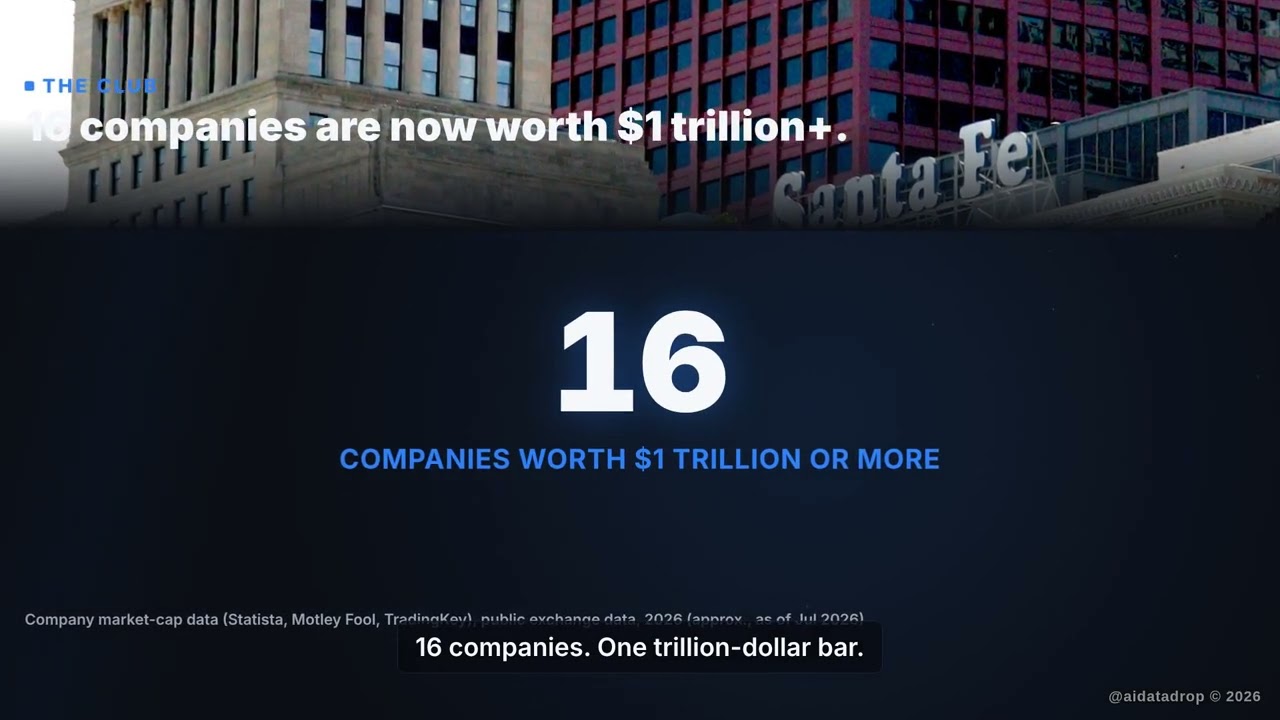
The "trillion-dollar company club" refers to an exclusive group of publicly traded companies whose total market capitalization (the total value of their outstanding shares) has reached or surpassed $1 trillion. This status signifies immense economic power, global influence, and often, technological leadership.
While the list can fluctuate with market dynamics, key companies that have achieved and often maintain trillion-dollar valuations include Apple, Microsoft, Alphabet (Google's parent company), Amazon, and Nvidia. Saudi Aramco (an oil and gas company) has also reached this valuation, demonstrating that not all members are tech-focused.
Companies reach a $1 trillion valuation through a combination of factors, including generating substantial and growing revenues, achieving global market dominance, developing innovative products or services, building strong brand loyalty, and leveraging scalable business models (like software, cloud services, and e-commerce). Significant investments in and successful integration of transformative technologies like AI are increasingly crucial drivers.
The rise of multiple trillion-dollar companies indicates significant economic concentration and the dominance of specific industries, primarily technology. It can drive massive innovation and investment but also raises concerns about market monopolies, regulatory challenges, and their profound impact on global employment, data privacy, and geopolitical influence.
Dive deeper into the fascinating world of hyper-scale corporations and uncover the full story behind their unprecedented rise. Watch the original video on @aidatadrop to get more insights and subscribe for cutting-edge facts on AI and data!