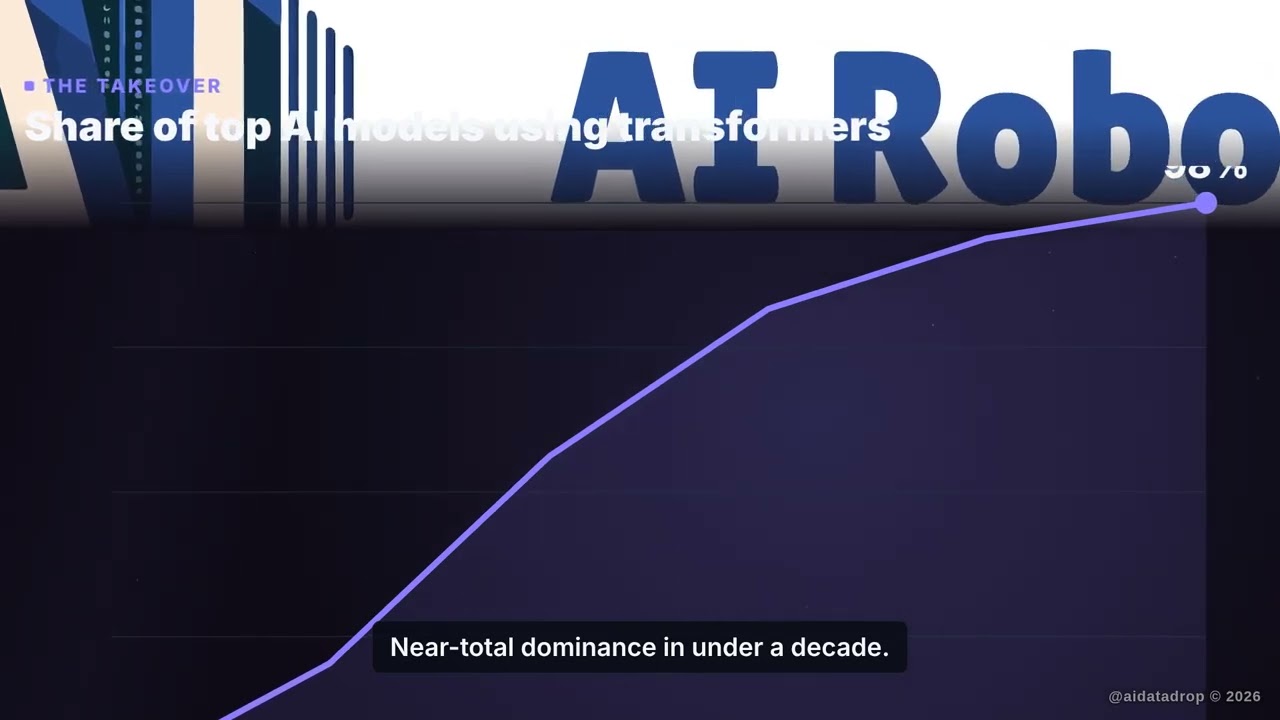
How One 2017 Paper Took Over All of AI 🧠
August 04, 2026 — ny_wk
As an Amazon Associate I earn from qualifying purchases.
As an Amazon Associate I earn from qualifying purchases.
As an Amazon Associate I earn from qualifying purchases.
As an Amazon Associate I earn from qualifying purchases.
As an Amazon Associate I earn from qualifying purchases.
As an Amazon Associate I earn from qualifying purchases.
As an Amazon Associate I earn from qualifying purchases.
As an Amazon Associate I earn from qualifying purchases.
As an Amazon Associate I earn from qualifying purchases.
As an Amazon Associate I earn from qualifying purchases.
As an Amazon Associate I earn from qualifying purchases.
As an Amazon Associate I earn from qualifying purchases.
As an Amazon Associate I earn from qualifying purchases.
As an Amazon Associate I earn from qualifying purchases.
As an Amazon Associate I earn from qualifying purchases.
As an Amazon Associate I earn from qualifying purchases.
As an Amazon Associate I earn from qualifying purchases.
As an Amazon Associate I earn from qualifying purchases.
As an Amazon Associate I earn from qualifying purchases.
As an Amazon Associate I earn from qualifying purchases.
As an Amazon Associate I earn from qualifying purchases.
As an Amazon Associate I earn from qualifying purchases.
As an Amazon Associate I earn from qualifying purchases.
As an Amazon Associate I earn from qualifying purchases.
As an Amazon Associate I earn from qualifying purchases.
As an Amazon Associate I earn from qualifying purchases.
As an Amazon Associate I earn from qualifying purchases.
As an Amazon Associate I earn from qualifying purchases.
As an Amazon Associate I earn from qualifying purchases.
As an Amazon Associate I earn from qualifying purchases.
As an Amazon Associate I earn from qualifying purchases.
As an Amazon Associate I earn from qualifying purchases.
As an Amazon Associate I earn from qualifying purchases.
As an Amazon Associate I earn from qualifying purchases.
As an Amazon Associate I earn from qualifying purchases.
As an Amazon Associate I earn from qualifying purchases.
As an Amazon Associate I earn from qualifying purchases.
As an Amazon Associate I earn from qualifying purchases.
As an Amazon Associate I earn from qualifying purchases.
As an Amazon Associate I earn from qualifying purchases.
As an Amazon Associate I earn from qualifying purchases.
As an Amazon Associate I earn from qualifying purchases.
As an Amazon Associate I earn from qualifying purchases.
As an Amazon Associate I earn from qualifying purchases.
As an Amazon Associate I earn from qualifying purchases.
As an Amazon Associate I earn from qualifying purchases.
As an Amazon Associate I earn from qualifying purchases.
As an Amazon Associate I earn from qualifying purchases.
As an Amazon Associate I earn from qualifying purchases.
As an Amazon Associate I earn from qualifying purchases.
As an Amazon Associate I earn from qualifying purchases.
As an Amazon Associate I earn from qualifying purchases.
As an Amazon Associate I earn from qualifying purchases.
As an Amazon Associate I earn from qualifying purchases.
As an Amazon Associate I earn from qualifying purchases.
As an Amazon Associate I earn from qualifying purchases.
As an Amazon Associate I earn from qualifying purchases.
As an Amazon Associate I earn from qualifying purchases.
As an Amazon Associate I earn from qualifying purchases.
As an Amazon Associate I earn from qualifying purchases.
As an Amazon Associate I earn from qualifying purchases.
As an Amazon Associate I earn from qualifying purchases.
As an Amazon Associate I earn from qualifying purchases.
🛒 Recommended gear on AmazonDisclosure: some links above are affiliate links — if you buy through them I may earn a small commission at no extra cost to you. Thanks for supporting the channel!
In a world increasingly shaped by artificial intelligence, one seminal research paper from 2017 is the bedrock of nearly every groundbreaking AI advance we witness today: "Attention Is All You Need." This single publication introduced the Transformer architecture and the ingenious Attention mechanism, irrevocably changing the trajectory of AI development and powering the large language models (LLMs) like GPT-4 and Bard that are redefining how we interact with technology.
The year 2017 might feel like a lifetime ago in the fast-paced realm of AI, but its significance cannot be overstated. Before this pivotal moment, the leading contenders for processing sequential data like human language were recurrent neural networks (RNNs) and their more sophisticated cousins, Long Short-Term Memory (LSTM) networks. While powerful for their time, these architectures suffered from inherent limitations that bottlenecked progress, especially when dealing with increasingly complex tasks and vast datasets. Enter the Transformer, a paradigm shift that not only solved these issues but released an era of unprecedented scale and capability, truly taking over all of AI.
The Pre-Transformer Landscape: Chasing Context in a Sequential World
To truly appreciate the revolution brought by "Attention Is All You Need," it's crucial to understand the challenges that plagued AI development in natural language processing (NLP) before 2017. For decades, sequential data—anything from a sentence to a time series—was predominantly handled by recurrent neural networks. RNNs process information one token (word, character, data point) at a time, maintaining a "hidden state" that theoretically captures context from previous tokens. This sequential processing, however, was both their strength and their Achilles' heel.
The Bottlenecks of Recurrence: Why RNNs and LSTMs Fell Short
- Vanishing/Exploding Gradients: A classic problem in deep learning, especially prevalent in RNNs. As information propagates through many time steps, gradients (the signals used to update network weights during training) can either shrink to near zero (vanishing) or grow uncontrollably (exploding). Vanishing gradients, in particular, made it incredibly difficult for RNNs to learn long-range dependencies – understanding how a word at the beginning of a long sentence relates to a word at the end.
- Sequential Processing and Parallelization: The very nature of RNNs—processing tokens one after another—meant that training was inherently slow. Each step depended on the output of the previous step, preventing parallel computation across a sequence. As datasets grew exponentially larger, this became an insurmountable bottleneck for scalability and efficiency. Training models on massive text corpora would take an impractical amount of time.
- Fixed-Size Context Window: Although LSTMs and Gated Recurrent Units (GRUs) introduced "gates" to better control information flow and mitigate vanishing gradients, they still struggled with maintaining context over very long sequences. Their hidden state effectively acted as a fixed-size memory, making it challenging to recall or connect information that appeared hundreds or thousands of tokens apart. Imagine trying to summarize a multi-paragraph article with a tiny Post-it note – that was the challenge for these models.
- Memory Constraints: For very long sequences, storing and processing the hidden states could consume significant memory, further limiting the practical application of RNN-based models to increasingly complex tasks.
These limitations meant that while RNNs and LSTMs achieved respectable results on tasks like machine translation, text summarization, and sentiment analysis for shorter texts, they struggled to scale to the demands of truly understanding and generating human language at a sophisticated level. Researchers yearned for an architecture that could efficiently grasp context across vast distances and exploit the power of parallel computing hardware like GPUs.
"Attention Is All You Need": The Genesis of a Giant
In June 2017, a team of researchers from Google Brain and Google Research — Ashish Vaswani, Noam Shazeer, Niki Parmar, Jakob Uszkoreit, Llion Jones, Aidan N. Gomez, Łukasz Kaiser, and Illia Polosukhin — published a paper that would completely upend this landscape. Titled "Attention Is All You Need," their work introduced the Transformer, an architecture that famously discarded recurrence and convolutions in favor of a novel mechanism: self-attention.
The core insight was elegant yet revolutionary: instead of processing tokens sequentially, what if the model could weigh the importance of *all* other tokens in the input sequence when processing a single token? What if it could "attend" to different parts of the input simultaneously, much like how humans might scan different parts of a sentence to grasp its full meaning? This idea, while not entirely new (attention mechanisms had appeared in various forms before), was applied in a fundamentally different way, becoming the *sole* mechanism for relating different positions of the input or output sequence.
The Core Innovation: The Attention Mechanism
At the heart of the Transformer is the Attention mechanism, specifically Self-Attention and Multi-Head Attention. This is where the magic happens:
Imagine processing the word "bank" in the sentence "The financial bank is near the river bank." An RNN would process "financial bank" and then "river bank," potentially struggling to distinguish between the two meanings without explicit mechanisms. Self-attention, however, allows the model to look at "financial" when encoding the first "bank" and "river" when encoding the second "bank," simultaneously deriving context from both. It calculates a weighted sum of all other words in the input, where the weights determine how much each word contributes to the representation of the current word.
The mathematical formulation of attention involves three key vectors derived from each input token: Query (Q), Key (K), and Value (V).
- The Query vector represents the current word we are trying to encode.
- The Key vectors represent all other words in the input sequence, acting like labels or descriptors.
- The Value vectors contain the actual information content of those other words.
To determine how much attention a query word should pay to a key word, the Transformer calculates a similarity score between Q and K (typically via a dot product). These scores are then scaled and passed through a softmax function to get a probability distribution, ensuring the weights sum to 1. Finally, these attention weights are multiplied by the Value vectors, and the results are summed up to create a new, context-rich representation for the query word. This entire process happens for every word in the input sequence, in parallel.
Multi-Head Attention: Diverse Perspectives on Context
A single attention mechanism might focus on specific relationships. To enrich this, the Transformer employs Multi-Head Attention. This means the attention mechanism isn't run just once, but multiple times in parallel, each with its own set of Q, K, and V weight matrices. Each "head" learns to focus on different aspects of the input sequence or different types of relationships. For example, one head might learn syntactic relationships, while another focuses on semantic connections. The outputs from these multiple heads are then concatenated and linearly transformed, providing a more comprehensive and robust contextual understanding.
Deconstructing the Transformer: A Blueprint for Modern AI
Beyond the attention mechanism, the Transformer architecture is a meticulously designed system that leverages this innovation to its fullest. It consists of an encoder-decoder structure, though many modern applications use only the encoder or the decoder stack.
The Encoder Stack: Understanding Input Sequences
The encoder is responsible for processing the input sequence (e.g., a sentence in English for translation). It is composed of a stack of identical layers. Each encoder layer has two primary sub-layers:
- Multi-Head Self-Attention Mechanism: As described above, this sub-layer allows the encoder to weigh the importance of all other words in the input sequence when encoding each individual word.
- Position-wise Feed-Forward Network: This is a simple, fully connected feed-forward network applied independently to each position. It provides a means for the model to process the context-rich representation produced by the attention layer further.
Crucially, each sub-layer in the encoder (and decoder) has a residual connection around it, followed by layer normalization. Residual connections help with training very deep networks by allowing gradients to flow more easily, while layer normalization stabilizes training by normalizing the inputs to each sub-layer.
The Decoder Stack: Generating Output Sequences
The decoder stack, also composed of identical layers, is responsible for generating the output sequence (e.g., the translated sentence in French). Each decoder layer has three main sub-layers:
- Masked Multi-Head Self-Attention: Similar to the encoder's self-attention, but "masked." This masking ensures that when predicting the next word, the decoder can only attend to previously generated words, preventing it from "cheating" by looking at future words in the target sequence.
- Multi-Head Encoder-Decoder Attention: This unique attention layer allows the decoder to attend to the output of the *encoder stack*. This is critical for tasks like machine translation, where the decoder needs to align parts of the output sequence with relevant parts of the input sequence. The queries come from the previous decoder layer, while the keys and values come from the encoder's output.
- Position-wise Feed-Forward Network: Similar to the encoder's feed-forward network.
Again, residual connections and layer normalization are applied around each sub-layer.
The Missing Piece: Positional Encoding
Since the Transformer jettisoned recurrence, it lost the inherent notion of word order that RNNs naturally provided. To reintroduce this crucial sequential information, the authors devised Positional Encoding. Before passing the input embeddings to the encoder (and similarly for the decoder), a vector is added to each input embedding that encodes the word's absolute or relative position in the sequence. These positional encodings are typically sinusoidal functions of different frequencies, allowing the model to distinguish between words at different positions without disrupting the parallel processing capabilities.
The Game-Changing Advantages of the Transformer
The culmination of these architectural choices resulted in several monumental advantages over previous models:
- Unprecedented Parallelization: By eliminating sequential recurrence, the Transformer could process all words in an input sequence simultaneously. This was a big deal for training efficiency, allowing models to leverage GPUs and TPUs to their full potential and train on vastly larger datasets in a fraction of the time.
- Superior Long-Range Dependency Handling: The self-attention mechanism, by directly connecting any two words in a sequence regardless of their distance, elegantly solved the vanishing gradient problem and allowed the model to effectively capture dependencies across very long texts. This was a key factor in improving performance on complex language understanding tasks.
- Increased Model Capacity: The ability to scale led to larger models with more parameters, which in turn could learn more intricate patterns and representations of language.
- Reduced Training Time: As mentioned, parallelization significantly cut down the time required to train state-of-the-art models from weeks to days or even hours for smaller datasets.
- Interpretability (to an extent): While deep learning models are often black boxes, the attention weights within Transformers can offer some insights into which parts of the input the model is focusing on for a particular prediction, providing a degree of explainability.
From Research Paper to AI Revolution: The Unstoppable Rise of Transformers
The publication of "Attention Is All You Need" wasn't just a ripple; it was a tidal wave that washed over the entire AI research landscape. Its implications were almost immediately recognized, and within a couple of years, the Transformer architecture became the undisputed foundation for state-of-the-art models across a multitude of domains.
Transforming Natural Language Processing (NLP)
NLP was the immediate beneficiary. The Transformer provided the perfect architecture for pre-training large language models on massive amounts of text data, allowing them to learn incredibly rich and generalized representations of language. This led to a series of breakthroughs:
- BERT (Bidirectional Encoder Representations from Transformers): Developed by Google in 2018, BERT was one of the first and most influential Transformer-based models. It demonstrated the power of pre-training a deep bidirectional Transformer encoder on a huge corpus of text and then fine-tuning it for various downstream NLP tasks (question answering, sentiment analysis, named entity recognition) with remarkable results.
- GPT Series (Generative Pre-trained Transformer): OpenAI's series of models, starting with GPT in 2018, GPT-2 in 2019, GPT-3 in 2020, and the awe-inspiring GPT-4 in 2023, are all built upon the Transformer's decoder-only architecture. These models showcased unparalleled capabilities in language generation, coherent text completion, creative writing, and complex reasoning, truly pushing the boundaries of what AI can do with text. GPT-4, for instance, can ace standardized exams and generate diverse, high-quality content across modalities, a sign of the Transformer's scalability.
- T5 (Text-to-Text Transfer Transformer): Google's T5, released in 2019, solidified the "text-to-text" paradigm, framing every NLP problem as taking text as input and producing text as output, using a Transformer encoder-decoder architecture. This unified approach simplified model development and achieved state-of-the-art results across a wide range of tasks.
- Other Giants: Models like XLNet, RoBERTa, Electra, LaMDA, PaLM, LLaMA, and many more, all leverage the Transformer architecture as their core. They continually push the boundaries of model size, efficiency, and performance.
The Transformer enabled models to develop a deep, nuanced understanding of context, grammar, semantics, and even implicit knowledge embedded in human language, leading to applications that were once science fiction: highly accurate machine translation, intelligent chatbots, sophisticated content generation, and intricate summarization.
Beyond Language: The Reach of the Transformer into Other AI Fields
The influence of the Transformer didn't stop at NLP. Its core principle of attention and parallel processing proved so universally powerful that it began to infiltrate other domains:
- Computer Vision (Vision Transformers - ViT): Initially, convolutional neural networks (CNNs) dominated computer vision. However, in 2020, Google researchers demonstrated that Transformers, when applied to sequences of image patches, could achieve competitive or even superior results on image classification tasks. This led to the rapid development of Vision Transformers (ViT) and subsequent architectures like Swin Transformers, DPT, and more, showing that sequential processing of visual information using attention was incredibly effective.
- Speech Recognition and Synthesis: Transformers are now a cornerstone in modern speech processing, improving accuracy in automatic speech recognition (ASR) systems and generating more natural-sounding synthetic voices.
- Reinforcement Learning: Transformers are being integrated into reinforcement learning agents to better understand complex environments and long-term decision-making.
- Drug Discovery and Bioinformatics: The ability of Transformers to model relationships in sequences makes them ideal for analyzing protein sequences, DNA, and molecular structures, accelerating drug discovery and understanding biological processes.
- Multimodal AI: Perhaps one of the most exciting frontiers, Transformers are central to models that can smoothly understand and generate content across different modalities—text, images, video, and audio. Models like DALL-E, Stable Diffusion, and GPT-4 (with its visual input capabilities) are prime examples, using Transformer-based architectures to align and generate content across these diverse data types. Learn more about the fascinating world of large language models.
The Transformer architecture’s versatility lies in its ability to model relationships between arbitrary tokens in a sequence, irrespective of the nature of those tokens (words, pixels, audio snippets). This generalized relational inductive bias has made it a foundational component for almost all advanced AI models today.
Why It Matters Right Now: The Era of Generative AI and Beyond
Fast forward to today, and the "Attention Is All You Need" paper from 2017 is not just a historical artifact; it's the beating heart of the AI revolution unfolding before our eyes. Every time you interact with a sophisticated chatbot, generate an image from a text prompt, get a highly relevant search result, or use a tool that auto-completes your code, you are likely leveraging the power of a Transformer-based model.
- The Age of Large Language Models (LLMs): The current explosion of interest and capability in LLMs is directly attributable to the Transformer. Its architecture allows for scaling to billions, even trillions, of parameters, which is essential for capturing the nuances and vastness of human knowledge encoded in massive datasets. These models are not merely statistical predictors; they demonstrate emergent abilities, performing complex tasks and reasoning in ways that were unimaginable just a few years ago.
- Accelerating Innovation: The open-sourcing of Transformer implementations and pre-trained models has democratized advanced AI, allowing researchers and developers worldwide to build upon this robust foundation. This rapid iteration and experimentation are pushing the boundaries of what AI can achieve at an unprecedented pace.
- New Human-Computer Interaction: Transformers are enabling more natural, intuitive, and powerful ways for humans to interact with computers. We are moving beyond rigid commands to conversational interfaces that understand context, nuance, and intent.
- Driving Economic and Societal Change: From automating customer service and generating creative content to accelerating scientific discovery and powering personalized education, Transformer-based AI is poised to reshape industries and societies globally. Understanding its mechanics is no longer just for AI specialists; it's becoming essential for anyone looking to navigate the future.
While challenges remain—such as the enormous computational resources required, issues of bias in training data, and the need for robust ethical guidelines—the Transformer continues to evolve. Researchers are developing more efficient variants, exploring its theoretical underpinnings, and pushing its applications into even more uncharted territories. The 2017 paper didn't just introduce an architecture; it ignited a scientific and technological revolution that continues to redefine the boundaries of artificial intelligence.
For more insights into the foundational technologies driving AI, check out our piece on The Unseen Power of Data in AI Training.
Key Takeaways
- The "Attention Is All You Need" paper from 2017 introduced the revolutionary Transformer architecture, fundamentally changing AI.
- The core innovation is the Attention mechanism, specifically self-attention, which allows models to weigh the importance of all input elements simultaneously, overcoming the limitations of sequential processing.
- Transformers enable unprecedented parallelization in training, leading to faster development and the ability to train much larger models.
- They excel at capturing long-range dependencies in data, a crucial capability for understanding complex human language and other sequential information.
- The Transformer architecture is the bedrock for nearly all modern Large Language Models (LLMs) like GPT-3, GPT-4, and Bard, and has extended its influence to computer vision, speech, and multimodal AI.
Frequently Asked Questions
What is the Transformer architecture and why is it so important for AI?
The Transformer architecture is a deep learning model introduced in a 2017 paper by Google researchers. Its importance stems from its revolutionary use of the Attention mechanism, particularly self-attention, which allows it to process all parts of an input sequence (like a sentence) simultaneously, rather than one by one. This parallel processing capability drastically speeds up training, handles long-range dependencies more effectively than previous models (like RNNs), and enables the creation of incredibly large and powerful AI models. It forms the foundation of almost all modern large language models (LLMs) and advanced AI systems across various domains.
What is the Attention mechanism in Transformers?
The Attention mechanism is the key innovation within the Transformer architecture. It allows the model to dynamically weigh the importance of different parts of an input sequence when processing a specific element. For instance, when understanding a word in a sentence, attention allows the model to "look at" and prioritize other relevant words, regardless of their distance. This is achieved by calculating scores (usually via Queries, Keys, and Values) that determine how much focus each part of the input should receive, creating a rich, context-aware representation for every element in the sequence. Multi-head attention further enhances this by allowing the model to focus on different aspects of relationships simultaneously.
Which well-known AI models use the Transformer architecture?
Numerous groundbreaking AI models leverage the Transformer architecture. Some of the most prominent examples include Google's BERT (Bidirectional Encoder Representations from Transformers), which revolutionized natural language understanding; OpenAI's GPT series (Generative Pre-trained Transformer), including GPT-2, GPT-3, and the highly advanced GPT-4, known for their exceptional language generation capabilities; and Google's T5 (Text-to-Text Transfer Transformer). Beyond NLP, models like Vision Transformers (ViT) in computer vision, and multimodal AI systems like DALL-E and Stable Diffusion also rely heavily on Transformer components for their sophisticated abilities to understand and generate content across different data types.
How did the Transformer architecture overcome the limitations of previous AI models like RNNs?
The Transformer architecture primarily overcame the limitations of Recurrent Neural Networks (RNNs) by abandoning their sequential processing nature. RNNs process input tokens one at a time, making them slow to train due to lack of parallelization and prone to issues like vanishing gradients, which hindered their ability to capture long-range dependencies. The Transformer, by contrast, uses its Attention mechanism to process all tokens in a sequence in parallel. This enabled much faster training on massive datasets and allowed the model to directly learn relationships between distant tokens, making it far superior at understanding and generating complex, long-form content. This shift unlocked unprecedented scalability and performance for AI.
To dive deeper into the insights behind this pivotal paper and its lasting impact on artificial intelligence, be sure to watch the full video on the @aidatadrop channel and subscribe for more fascinating explorations into the world of AI!