Every AI Hype Cycle Since 1956, Explained ❄️
August 03, 2026 — ny_wk
As an Amazon Associate I earn from qualifying purchases.
As an Amazon Associate I earn from qualifying purchases.
As an Amazon Associate I earn from qualifying purchases.
As an Amazon Associate I earn from qualifying purchases.
As an Amazon Associate I earn from qualifying purchases.
As an Amazon Associate I earn from qualifying purchases.
As an Amazon Associate I earn from qualifying purchases.
As an Amazon Associate I earn from qualifying purchases.
As an Amazon Associate I earn from qualifying purchases.
As an Amazon Associate I earn from qualifying purchases.
As an Amazon Associate I earn from qualifying purchases.
As an Amazon Associate I earn from qualifying purchases.
As an Amazon Associate I earn from qualifying purchases.
As an Amazon Associate I earn from qualifying purchases.
As an Amazon Associate I earn from qualifying purchases.
As an Amazon Associate I earn from qualifying purchases.
As an Amazon Associate I earn from qualifying purchases.
As an Amazon Associate I earn from qualifying purchases.
As an Amazon Associate I earn from qualifying purchases.
As an Amazon Associate I earn from qualifying purchases.
As an Amazon Associate I earn from qualifying purchases.
As an Amazon Associate I earn from qualifying purchases.
As an Amazon Associate I earn from qualifying purchases.
As an Amazon Associate I earn from qualifying purchases.
As an Amazon Associate I earn from qualifying purchases.
As an Amazon Associate I earn from qualifying purchases.
As an Amazon Associate I earn from qualifying purchases.
As an Amazon Associate I earn from qualifying purchases.
As an Amazon Associate I earn from qualifying purchases.
As an Amazon Associate I earn from qualifying purchases.
As an Amazon Associate I earn from qualifying purchases.
As an Amazon Associate I earn from qualifying purchases.
As an Amazon Associate I earn from qualifying purchases.
As an Amazon Associate I earn from qualifying purchases.
As an Amazon Associate I earn from qualifying purchases.
As an Amazon Associate I earn from qualifying purchases.
As an Amazon Associate I earn from qualifying purchases.
As an Amazon Associate I earn from qualifying purchases.
As an Amazon Associate I earn from qualifying purchases.
As an Amazon Associate I earn from qualifying purchases.
As an Amazon Associate I earn from qualifying purchases.
As an Amazon Associate I earn from qualifying purchases.
As an Amazon Associate I earn from qualifying purchases.
As an Amazon Associate I earn from qualifying purchases.
As an Amazon Associate I earn from qualifying purchases.
As an Amazon Associate I earn from qualifying purchases.
As an Amazon Associate I earn from qualifying purchases.
As an Amazon Associate I earn from qualifying purchases.
As an Amazon Associate I earn from qualifying purchases.
As an Amazon Associate I earn from qualifying purchases.
As an Amazon Associate I earn from qualifying purchases.
As an Amazon Associate I earn from qualifying purchases.
As an Amazon Associate I earn from qualifying purchases.
As an Amazon Associate I earn from qualifying purchases.
As an Amazon Associate I earn from qualifying purchases.
As an Amazon Associate I earn from qualifying purchases.
As an Amazon Associate I earn from qualifying purchases.
As an Amazon Associate I earn from qualifying purchases.
As an Amazon Associate I earn from qualifying purchases.
As an Amazon Associate I earn from qualifying purchases.
As an Amazon Associate I earn from qualifying purchases.
As an Amazon Associate I earn from qualifying purchases.
As an Amazon Associate I earn from qualifying purchases.
As an Amazon Associate I earn from qualifying purchases.
🛒 Recommended gear on AmazonDisclosure: some links above are affiliate links — if you buy through them I may earn a small commission at no extra cost to you. Thanks for supporting the channel!
From the first glimmer of artificial intelligence in the 1950s to the current explosion of generative AI, the journey has been anything but a straight line. Understanding the undulating waves of excitement, investment, and subsequent disillusionment—known as AI hype cycles—is crucial for anyone working through the present and future of this transformative technology.
Artificial intelligence has always been a field of immense promise, periodically captivating the public imagination with visions of intelligent machines that could revolutionize every aspect of life. Yet, for every soaring peak of optimism, there has inevitably followed a trough of skepticism, dwindling funding, and a period often grimly referred to as an "AI winter." These cyclical patterns are not mere historical footnotes; they are fundamental lessons in technological maturation, revealing the intricate dance between human ambition, scientific breakthroughs, computational limitations, and market realities. Delving into the annals of AI history, we uncover a fascinating narrative of repeated ascents and descents, each one shaping the very trajectory of the intelligent systems we interact with today.
The Dawn of AI: Early Promises and the First Winter (1950s-1970s)
The genesis of artificial intelligence is typically traced back to a pivotal moment in the mid-20th century, a time brimming with post-war scientific optimism and the burgeoning capabilities of digital computers. The early pioneers, often brilliant polymaths from mathematics, logic, and computer science, envisioned machines that could not only perform calculations but also think, learn, and reason like humans.
The Dartmouth Summer Research Project: AI is Born
In the summer of 1956, a small but visionary group of scientists converged at Dartmouth College for a two-month workshop. Organized by John McCarthy, a young assistant professor of mathematics, alongside Marvin Minsky, Nathaniel Rochester, and Claude Shannon, the event aimed to explore the burgeoning field of "artificial intelligence." This workshop is widely recognized as the official birth of AI as a distinct academic discipline. The attendees, including luminaries like Allen Newell, Herbert A. Simon, and Arthur Samuel, were driven by the audacious hypothesis that "every aspect of learning or any other feature of intelligence can in principle be so precisely described that a machine can be made to simulate it." The optimism was palpable, fueled by early successes in theorem proving and game playing.
This early period was dominated by symbolic AI or "Good Old-Fashioned AI" (GOFAI), an approach predicated on the idea that human intelligence could be replicated by manipulating symbols according to a set of predefined rules. Researchers focused on creating systems that could solve problems by searching through vast spaces of possibilities, often using logic and heuristics. Programs like Newell and Simon's Logic Theorist (1956) and General Problem Solver (GPS, 1957) were early triumphs, demonstrating machines that could deduce theorems and solve intricate puzzles. Marvin Minsky's perceptron, though a precursor to neural networks, also contributed to the excitement, promising machines that could learn from data.
The Enthusiasm Builds: Logic, Lisp, and Problem Solvers
The 1960s saw a significant surge in enthusiasm and funding for AI research. The U.S. government, particularly the Department of Defense's Advanced Research Projects Agency (ARPA, later DARPA), invested heavily, recognizing the strategic potential of intelligent machines. Universities like MIT, Stanford, and Carnegie Mellon became hotbeds of AI innovation. Lisp, a programming language specifically designed for AI, emerged as a dominant tool, allowing researchers to rapidly prototype and experiment with complex symbolic manipulations.
Key achievements during this period included:
- ELIZA (1966): Developed by Joseph Weizenbaum at MIT, ELIZA was an early natural language processing program that simulated a Rogerian psychotherapist. While simple in its mechanisms (primarily pattern matching and rephrasing user input as questions), it famously fooled many users into believing they were conversing with a human, highlighting the powerful psychological impact of even rudimentary AI.
- SHRDLU (1972): Terry Winograd's SHRDLU program at MIT could understand natural language commands to manipulate virtual blocks in a "blocks world." It demonstrated impressive abilities in parsing language, planning actions, and answering questions about its environment, representing a significant step forward in understanding the nuances of language and context.
- Expertise in Narrow Domains: Projects like DENDRAL (1965), developed at Stanford, began to show the potential for AI in specific scientific domains. DENDRAL could deduce the molecular structure of organic compounds from mass spectrometry data, showcasing the power of embedding specialized knowledge into AI systems.
These successes, though often confined to "toy problems" or highly constrained environments, fueled a strong belief that general human-level intelligence was just around the corner. Prominent figures like Marvin Minsky famously stated in 1967, "Within a generation, I am sure that the problem of creating 'artificial intelligence' will be substantially solved." The media, ever eager for a captivating narrative, amplified these predictions, setting the stage for inevitable disappointment.
The First Frost: Why the Initial AI Winter Set In
By the early 1970s, the initial euphoria began to wane, giving way to growing skepticism. The grand promises made in the 1960s were largely unfulfilled. AI programs, while impressive in their limited domains, struggled to scale to real-world complexity. They lacked common sense, couldn't generalize their knowledge, and were incredibly brittle – failing spectacularly when confronted with situations even slightly outside their predefined knowledge bases.
Several critical factors contributed to the onset of the first AI winter:
- Computational Limitations: Early computers were excruciatingly slow and had minuscule memory compared to today's machines. The ambitious symbolic manipulation and search algorithms of the time quickly hit computational bottlenecks, rendering them impractical for anything but the simplest problems.
- The Lighthill Report (1973): In the UK, Professor Sir James Lighthill was commissioned by the government to review the state of AI research. His scathing report concluded that "in no part of the field have discoveries made so far produced the major impact that was then promised." He criticized AI for failing to address "real-world problems" and for producing "toy" examples. The report led to drastic cuts in AI funding in Britain.
- The ALPAC Report (1966): Even earlier, the Automatic Language Processing Advisory Committee (ALPAC) report, commissioned by the U.S. government, heavily criticized machine translation research, highlighting its high costs and low quality. This report led to a significant reduction in funding for natural language processing research in the U.S.
- The Frame Problem: This philosophical and practical challenge highlighted the difficulty of representing dynamic knowledge in symbolic AI. How does an AI system know which facts in its knowledge base are relevant or irrelevant when a situation changes? This proved immensely complex to encode programmatically.
- The Problem of Common Sense: Researchers realized that human intelligence relies heavily on a vast, implicit reservoir of common-sense knowledge about the world – a knowledge base that proved incredibly difficult, if not impossible, to explicitly program into a machine.
As a result, funding dried up, research labs downsized or closed, and AI became a term to be avoided in academic circles. Many researchers pivoted to related fields like database systems or cognitive science, marking the end of the first major wave of AI enthusiasm.
The Expert Systems Era: A Glimmer of Hope and the Second Winter (1980s-1990s)
Just as the gloom of the first AI winter seemed to settle permanently, a new paradigm emerged from the ashes of symbolic AI: expert systems. This approach capitalized on the idea that while general intelligence was elusive, specialized intelligence in narrow domains could be effectively modeled.
Knowledge is Power: The Rise of Expert Systems
The 1980s witnessed a resurgence of interest and investment in AI, primarily driven by the success of expert systems. Instead of trying to mimic general human reasoning, these systems aimed to capture and apply the domain-specific knowledge of human experts. They consisted of two main components: a knowledge base (containing facts and rules elicited from human experts) and an inference engine (which applied those rules to derive conclusions).
Pioneering expert systems like MYCIN (developed at Stanford in the 1970s but gaining traction in the 80s) demonstrated impressive diagnostic capabilities in specific medical fields. MYCIN could diagnose blood infections and recommend treatments, often performing as well as or better than human doctors in its narrow specialty. Other notable expert systems included:
- R1/XCON (1978): Developed at Carnegie Mellon and later used by Digital Equipment Corporation (DEC), R1 configured computer systems. It was one of the first commercially successful expert systems, saving DEC millions of dollars annually by automating a complex and error-prone task previously performed by human experts.
- PROSPECTOR (1978): A geological expert system developed at Stanford, PROSPECTOR successfully identified a significant molybdenum deposit in Washington State, validating the commercial potential of AI in resource exploration.
The success of these systems, particularly in corporate settings, sparked a new wave of optimism. Companies formed dedicated AI departments, venture capitalists poured money into AI startups, and a new industry of "knowledge engineers" emerged, tasked with extracting expertise from humans and encoding it into machines. Japan's ambitious Fifth Generation Computer Systems project (FGCS), launched in 1981, aimed to build supercomputers with native AI capabilities, further fueling the global excitement.
Over-Promised, Under-Delivered: The Seeds of Disillusionment
Despite their initial commercial success, expert systems carried inherent limitations that eventually led to their downfall and ushered in the second AI winter. The enthusiasm of the early 80s again led to over-promising and an underestimation of the challenges involved in scaling these systems.
- Knowledge Acquisition Bottleneck: Eliciting knowledge from human experts and translating it into a formal, rule-based system was an incredibly labor-intensive, time-consuming, and expensive process. Experts were often unable to fully articulate their implicit decision-making processes, making it difficult to capture their expertise completely.
- Brittleness and Maintenance: Expert systems were inherently brittle. They performed well within their narrowly defined domains but failed catastrophically when faced with situations outside their knowledge base. Updating and maintaining these systems as new knowledge emerged or as company policies changed was a monumental task, often requiring significant reprogramming. Their codebase became unwieldy and difficult to manage.
- Lack of Common Sense and Learning: Like their symbolic AI predecessors, expert systems lacked common sense reasoning. They couldn't learn from experience or adapt to novel situations without explicit human intervention. This made them inflexible and limited their utility in dynamic environments.
- High Costs: The development, deployment, and maintenance of expert systems were exorbitantly expensive. Many companies found that the return on investment didn't always justify the significant outlay, especially as simpler, more conventional software solutions began to offer competitive alternatives.
- The "AI Winter" Perception: As disillusionment grew, many of the specialized AI companies that had sprung up went out of business or were acquired. Major investors pulled back, and the term "AI" again became toxic, with researchers often rebranding their work as "knowledge-based systems" or "computational intelligence" to secure funding.
The Long Chill: A Deeper Dive into the Second AI Winter
The period from the late 1980s through the 1990s is characterized as the second, and arguably longer and colder, AI winter. Funding dried up again, university departments lost staff, and public perception of AI became highly cynical. The ambitious FGCS project in Japan, after consuming billions of dollars, ultimately failed to deliver on its promise of revolutionary AI hardware and software, further dampening global enthusiasm.
During this period, however, crucial foundational work was being laid, often quietly and without the fanfare of previous eras. Researchers began to pivot away from purely symbolic approaches towards statistical methods and, crucially, towards nascent forms of machine learning. The rise of machine learning, particularly connectionist models (neural networks), offered an alternative path. While early neural networks had been dismissed in the 1960s (partly due to Minsky and Papert's "Perceptrons" book highlighting their limitations), renewed interest was sparked by new algorithms like backpropagation. However, even these early machine learning approaches struggled with computational power, data availability, and the 'vanishing gradient problem', meaning they were unable to realize their full potential.
This long chill forced a period of introspection within the AI community. Researchers learned valuable lessons about the pitfalls of over-promising, the importance of robust evaluation, and the need for more adaptable and data-driven approaches. The focus shifted from replicating human thought processes to building intelligent agents that could perform specific tasks effectively, even if their internal workings weren't fully explainable in human-like terms. This quiet persistence laid the groundwork for the next major revolution.
The Quiet Revolution: Statistical AI, Machine Learning, and the Path to Deep Learning (2000s-2010s)
The late 1990s and early 2000s saw a gradual, almost imperceptible thawing of the AI winter. This wasn't heralded by dramatic breakthroughs or bombastic predictions, but rather by a steady accumulation of progress in specific subfields, driven by fundamental shifts in computational power, data availability, and algorithmic innovation.
From Symbolic to Statistical: A Paradigm Shift
The dominant paradigm shifted decisively from symbolic, rule-based AI to statistical AI and machine learning. Instead of explicitly programming rules, researchers began to develop algorithms that could learn patterns and make predictions from vast datasets. This approach was far more robust, adaptable, and less brittle than its predecessors.
Key developments and algorithms during this period included:
- Support Vector Machines (SVMs): Highly effective for classification and regression tasks, SVMs became a workhorse algorithm, particularly for tasks like text categorization and bioinformatics.
- Random Forests and Ensemble Methods: These techniques combined multiple decision trees to improve accuracy and reduce overfitting, proving very successful across a wide range of applications.
- Probabilistic Models: Bayesian networks and Hidden Markov Models gained prominence for tasks involving uncertainty, such as speech recognition and bioinformatics.
- Natural Language Processing (NLP) Advances: With the rise of the internet, vast text corpora became available, enabling statistical NLP models to significantly improve performance in tasks like spam filtering, information retrieval, and machine translation (e.g., Google Translate, launched in 2006, initially used statistical machine translation).
The move to statistical methods meant that AI systems could handle the messy, ambiguous data of the real world far more effectively than symbolic systems. They could generalize better and were less reliant on perfect, explicit knowledge encoding.
The Data Deluge and Computational Power Surge
Two external forces were absolutely critical to the resurgence of AI: the explosion of data and the dramatic increase in computational power.
- The Data Deluge: The advent of the internet, the rise of social media, and the proliferation of digital sensors (from smartphone cameras to scientific instruments) led to an unprecedented availability of data. This "big data" was the fuel that statistical machine learning algorithms desperately needed to learn complex patterns. Without massive datasets of labeled examples, many of these algorithms would have remained theoretical curiosities.
- Computational Power: Moore's Law continued its relentless march, making powerful processors cheaper and more accessible. Furthermore, the gaming industry inadvertently provided AI with a critical new tool: the Graphics Processing Unit (GPU). GPUs, designed for parallel processing of graphics, proved to be exceptionally well-suited for the parallel computations required by machine learning algorithms, especially neural networks. This serendipitous alignment laid the foundation for the deep learning revolution.
This period also saw the development of large-scale open-source software frameworks and tools like Python libraries (NumPy, SciPy, scikit-learn), making machine learning more accessible to a wider community of researchers and practitioners. Data competitions, like the Netflix Prize, further spurred innovation and collaboration.
Early Deep Learning: The Undercurrent of Progress
Even during the peak of statistical machine learning, a small group of researchers continued to champion neural networks, often against considerable skepticism. Pioneers like Geoffrey Hinton, Yoshua Bengio, and Yann LeCun persisted in their work on deep learning—neural networks with multiple hidden layers. They developed critical techniques like unsupervised pre-training, dropout, and rectified linear units (ReLUs) to overcome challenges like the vanishing gradient problem and overfitting that had plagued earlier neural networks.
Early successes in the late 2000s, though not yet mainstream news, showed the promise of deep learning:
- Hinton's work on deep belief networks achieved state-of-the-art results in tasks like handwritten digit recognition.
- LeCun's convolutional neural networks (CNNs) were demonstrating superior performance in image recognition tasks, particularly in fields like handwritten digit classification (e.g., for postal codes).
These breakthroughs were quietly building momentum, creating an undercurrent of excitement that was about to burst onto the global stage.
The Deep Learning Explosion: The Current AI Hype Cycle (2012-Present)
The current AI hype cycle, arguably the most intense and widespread to date, was unequivocally ignited by a single, momentous event that occurred just over a decade ago. This era, dominated by deep learning, has catapulted AI from academic curiosity back into the forefront of public consciousness, promising capabilities that often feel like science fiction.
ImageNet and the GPU Breakthrough: A Turning Point
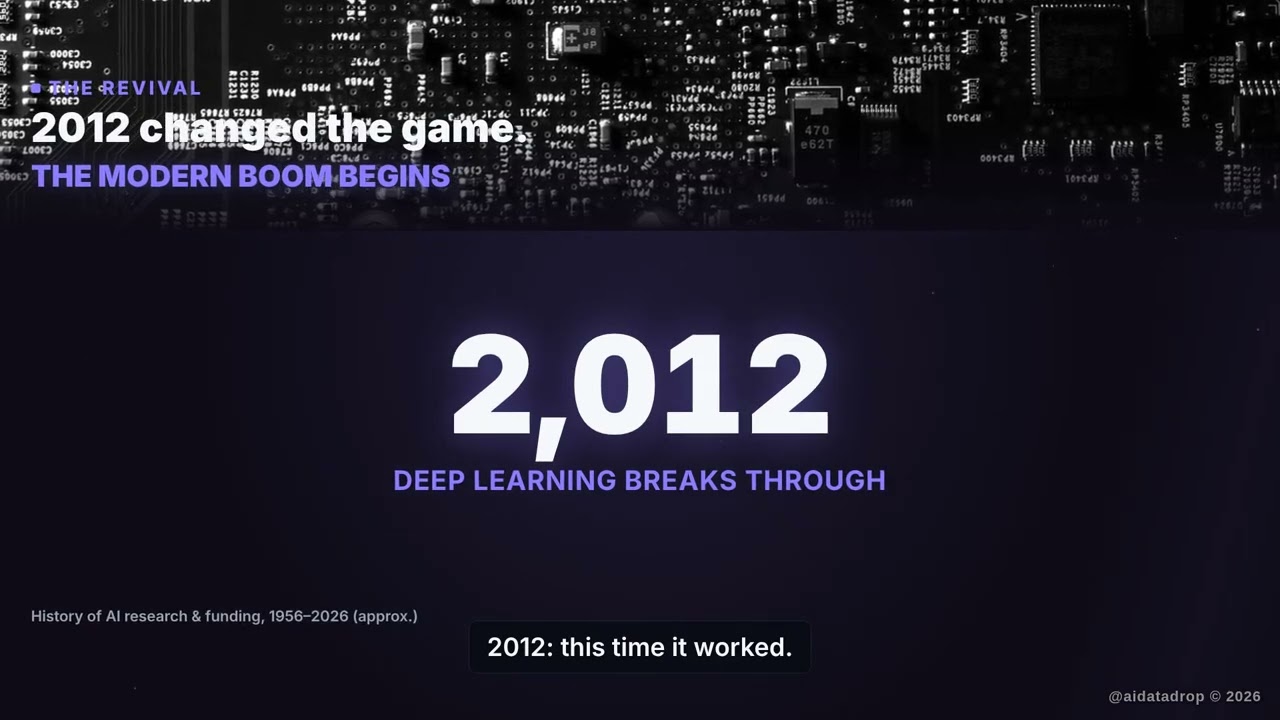
The year 2012 marked a definitive turning point. A team led by Geoffrey Hinton and his students Alex Krizhevsky and Ilya Sutskever at the University of Toronto trained a deep convolutional neural network, famously named AlexNet, to compete in the annual ImageNet Large Scale Visual Recognition Challenge (ILSVRC).
ImageNet is a vast dataset containing millions of labeled images across thousands of categories, making it a formidable benchmark for computer vision. AlexNet achieved a stunning breakthrough, drastically reducing the error rate in image classification compared to previous state-of-the-art methods. Its success was largely attributed to three critical factors:
- Deep Architecture: AlexNet was significantly deeper than previous neural networks, allowing it to learn more complex, hierarchical features from images.
- Massive Labeled Data: The sheer scale of the ImageNet dataset provided enough examples for the deep network to learn effectively without overfitting.
- GPU Acceleration: Crucially, AlexNet leveraged powerful GPUs to accelerate the training process, making it feasible to train such a large and deep network within a reasonable timeframe. Without the parallel processing power of GPUs, this feat would have been impossible.
The resounding success of AlexNet sent shockwaves through the computer vision community and, subsequently, the broader AI landscape. Researchers quickly realized the immense potential of deep learning, leading to a scramble to apply these techniques to various problems. This event undeniably kickstarted the current wave of AI hype.
Transformers, Generative AI, and the AGI Dream
Following ImageNet, deep learning rapidly expanded beyond image recognition. In 2018, Google introduced the Transformer architecture, a revolutionary neural network design primarily for natural language processing (NLP). Transformers, with their attention mechanisms, proved incredibly effective at processing sequences of data, enabling unprecedented advancements in understanding and generating human language. This led to a cascade of breakthroughs:
- Large Language Models (LLMs): Models like Google's BERT (2018) and OpenAI's GPT series (starting with GPT-2 in 2019, then GPT-3 in 2020, and GPT-4 in 2023) demonstrated increasingly sophisticated capabilities in tasks like text generation, summarization, translation, and question answering. These models, trained on unfathomable amounts of internet text, began to exhibit surprising emergent properties, leading to discussions about their potential for reasoning and even creativity.
- Generative AI Beyond Text: The generative capabilities of deep learning soon extended to other modalities. Generative Adversarial Networks (GANs) and later diffusion models (e.g., Stable Diffusion, Midjourney, DALL-E) revolutionized image generation, allowing users to create photorealistic images from simple text prompts. Similar advancements have been seen in video, audio, and even code generation.
- Reinforcement Learning and AI for Games: DeepMind's AlphaGo famously defeated the world champion of Go in 2016, a feat once thought to be decades away. Subsequent AI systems have mastered complex video games and even scientific problems like protein folding (AlphaFold).
These developments have sparked a fresh wave of public and private investment, with tech giants and startups alike pouring resources into AI research and product development. The discourse has again shifted, with renewed discussions about Artificial General Intelligence (AGI)—the elusive dream of machines possessing human-level cognitive abilities across a wide range of tasks.
working through the Peak: Is This Cycle Different?
We are currently at or near the peak of another AI hype cycle. The capabilities demonstrated by generative AI are genuinely astonishing, leading many to believe that "this time it's different." There are indeed compelling reasons to consider this era distinct from previous ones:
- Ubiquitous Data and Compute: The sheer scale of data available and the computational power (especially GPUs and specialized AI chips) far exceed anything available during previous cycles. This enables the training of models with billions or even trillions of parameters, leading to emergent behaviors that were previously impossible.
- Broader Impact: AI is no longer confined to specialized labs or narrow enterprise applications. It's integrated into our smartphones, search engines, recommendation systems, and now, through generative AI, is beginning to fundamentally alter creative and professional workflows for the general public.
- Generalization Capabilities: Modern deep learning models, particularly Transformers, show remarkable capabilities to generalize across tasks and even modalities (e.g., text-to-image, text-to-code). This multi-modality and broader applicability represent a significant leap from the brittle, domain-specific systems of the past.
- Economic Stakes: The economic implications are massive, with governments and corporations globally recognizing AI as a strategic imperative. The potential for productivity gains and new industries is unprecedented.
However, the lessons from previous AI hype cycles remain critically relevant. Skepticism, while often unpopular during peaks of enthusiasm, serves as a necessary check. Challenges persist:
- Ethical Concerns: Bias in data, potential for misuse (e.g., deepfakes, misinformation), job displacement, and the environmental impact of training massive models are significant and growing concerns.
- Interpretability and Explainability: Deep learning models are often "black boxes," making it difficult to understand their decision-making processes, which is crucial in sensitive applications like medicine or law.
- Hallucinations and Reliability: Generative AI models can "hallucinate" information, presenting false or nonsensical data as fact, posing challenges for accuracy and trustworthiness.
- Cost and Energy: Training and deploying the largest AI models require enormous computational resources and energy, raising questions about scalability and accessibility for smaller players.
- The AGI Conundrum: While current AI is powerful, it is still fundamentally different from human general intelligence. It lacks true understanding, common sense, and nuanced reasoning. The path to AGI remains unclear, and the timelines are highly debated.
Understanding the historical ebb and flow of AI hype allows us to approach the current excitement with a balanced perspective. It reminds us that while progress is undeniable and often transformative, it is rarely linear, and the journey from promise to pervasive reality is frequently fraught with unforeseen challenges.
Key Takeaways
- AI's History is Cyclical: The field of AI has consistently experienced periods of intense hype ("AI summers") followed by disillusionment and reduced funding ("AI winters").
- Over-Promising is a Consistent Pitfall: Each major hype cycle has been fueled by ambitious predictions that outstripped the technological capabilities of the time, leading to unmet expectations.
- Technological Limitations Drive Winters: The first two AI winters were primarily caused by insufficient computational power, lack of data, and the brittleness of symbolic and expert systems.
- Data and Compute are Modern Fuel: The current deep learning boom is largely enabled by the unprecedented availability of vast datasets and powerful, parallel processing hardware (especially GPUs).
- Every Winter Lays Groundwork: Despite the downturns, each AI winter forced introspection and fundamental research that eventually led to new breakthroughs, demonstrating resilience and iterative progress.
- The Current Cycle is Different, Yet Familiar: While current AI capabilities are unprecedented, particularly in generalization and generative power, concerns about ethical implications, reliability, and the elusive nature of AGI echo past cautionary tales.
Frequently Asked Questions
What is an AI Hype Cycle?
An AI hype cycle refers to the recurring pattern of exaggerated enthusiasm and inflated expectations for artificial intelligence, followed by a period of disillusionment, reduced funding, and skepticism, often dubbed an "AI winter." These cycles reflect the tension between ambitious predictions and the real-world limitations of current AI technology.
What caused the previous AI Winters?
The first AI winter (1970s) was primarily caused by the limitations of early computing power, the inability of symbolic AI to handle real-world complexity, the lack of common-sense reasoning, and critical government reports that cut funding. The second AI winter (late 1980s-1990s) resulted from the high costs, brittleness, and difficulty of maintaining expert systems, coupled with a knowledge acquisition bottleneck that made them impractical to scale and adapt.
Is the current AI boom likely to lead to another AI Winter?
While the current AI boom, driven by deep learning and generative AI, is unprecedented in its capabilities and widespread impact, the possibility of another AI winter is a topic of debate. Some argue that the fundamental advancements in data, computational power, and generalization make this cycle different. Others caution that challenges like ethical concerns, interpretability, cost, and the continued elusive nature of true AGI could still lead to disillusionment and a slowdown in investment if expectations aren't managed realistically. History suggests that while a complete shutdown is unlikely, a period of recalibration and slower progress is always possible after intense hype.
How does the "AI Hype Cycle" relate to the Gartner Hype Cycle?
The concept of the "AI Hype Cycle" predates and is often seen as a specific manifestation of the broader Gartner Hype Cycle. The Gartner Hype Cycle is a graphical representation of the maturity, adoption, and social application of specific technologies, typically following five phases: Innovation Trigger, Peak of Inflated Expectations, Trough of Disillusionment, Slope of Enlightenment, and Plateau of Productivity. AI's historical trajectory fits perfectly into this general model, repeatedly reaching the "Peak of Inflated Expectations" and then descending into the "Trough of Disillusionment," only to climb back out with new innovations.
The journey through AI's fascinating history of hype and retraction offers invaluable lessons for today's innovators, investors, and policymakers. It reminds us that progress is often made in fits and starts, and that true breakthroughs emerge from sustained effort, even during periods of skepticism. To truly grasp the nuances of AI's past and to better anticipate its future, we highly recommend you dig deeper into this captivating subject by watching the full video on every AI Hype Cycle since 1956. You can find it on the @aidatadrop channel – make sure to subscribe for more expert insights!